Breakfast is often cited as the most important meal of the day, but in the modern food landscapes of the USA, UK, and Canada, it has also become the most misunderstood. For the average person, the cereal aisle is a wall of bright colors, health claims, and confusing terminology. For the fitness enthusiast or someone managing a medical condition like diabetes or hypertension, this aisle can be a source of significant “nutritional sabotage.”
This guide will provide a deep dive into the science of cereal. We will explore how grains affect your physiology, how to outsmart marketing tactics, and how to select a bowl that supports your longevity.
Part 1: The Physiology of the Morning Meal
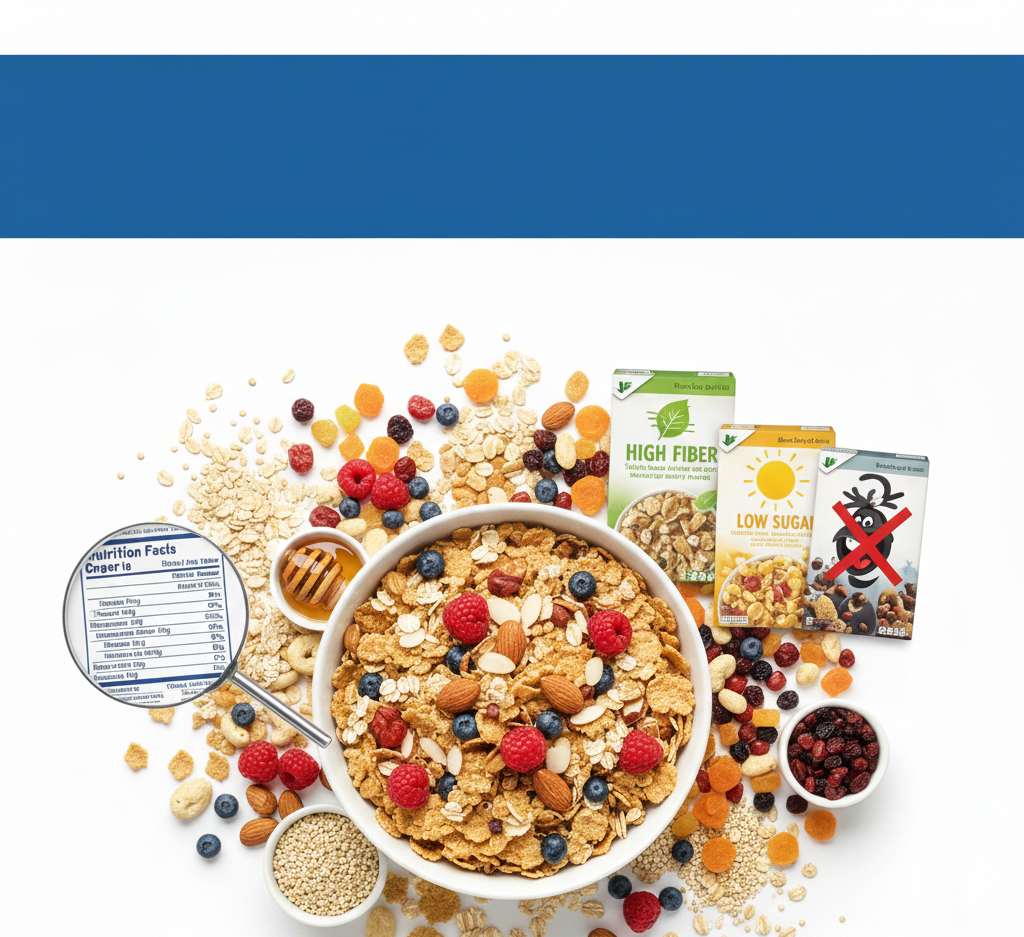
How to Identify Truly Nutritious Breakfast Cereals
To understand what makes a cereal “good,” we must first understand what happens inside your body when you eat.
The Role of Insulin and Blood Glucose
When you consume carbohydrates, your body breaks them down into glucose (sugar). In a clinical setting, we measure how fast this happens using the Glycemic Index (GI).
- High GI Cereals: These include cornflakes, puffed rice, and sugary loops. They digest rapidly, causing a sharp spike in blood sugar.
- The Pancreatic Response: In response to this spike, your pancreas pumps out insulin to move sugar into your cells.
- The Crash: Because the sugar was “simple” and lacked fiber, it leaves the bloodstream quickly, leaving you tired, hungry, and craving more sugar by 10:00 AM.
The Importance of the “Food Matrix”
In medical nutrition, the “matrix” refers to how nutrients are physically bound within the food. A whole grain has a complex matrix of fiber, protein, and starch. An “extruded” cereal (grains shaped into O’s or flakes through high heat and pressure) has a broken matrix. Even if the calories are the same, your body processes the whole grain much more efficiently than the processed flake.
Part 2: Decoding the Marketing “Health Halo”
In the USA (FDA), UK (FSA), and Canada (Health Canada), there are strict rules about what can be on a nutrition label, but “front-of-box” marketing is a different story.
1. The “Multigrain” Trap
“Multigrain” sounds healthy, but medically, it means nothing more than “more than one type of grain was used.” Those grains could all be refined white flour.
- What to look for instead: “100% Whole Grain.” This ensures the bran and germ are present.
2. “Made with Real Fruit”
Often, the “blueberries” or “strawberries” in cereal are actually small bits of dyed cornstarch or flavored gelatin.
- The Health Tip: Buy plain cereal and add your own fresh or frozen berries. You get real antioxidants and fiber without the artificial dyes (like Red 40 or Blue 1) which are under scrutiny for their effects on child behavior.
3. “Heart Healthy” Claims
Cereals high in soluble fiber (like oats) can indeed help lower LDL cholesterol. However, manufacturers often put this claim on boxes that also contain 12 grams of sugar. The sugar may cause inflammation that offsets the benefits of the fiber.
Part 3: The “Developer’s Checklist” for the Ingredient List
When I develop recipes or meal plans, I use a specific hierarchy of information. The ingredient list is more important than the calorie count.
Step 1: The First Three Ingredients
Ingredients are listed by weight. If any of the following are in the top three, the cereal is not a “health food”:
- Sugar/Cane Sugar
- High Fructose Corn Syrup
- Brown Sugar Syrup
- White Flour / Enriched Flour
Step 2: Identify the “Whole” Grains
A truly nutritious cereal should start with:
- Whole Oats
- Whole Wheat
- Spelt
- Barley
- Rye
Step 3: Check for Industrial Seed Oils
Many granolas use “Vegetable Oil,” “Soybean Oil,” or “Canola Oil.” While not inherently “poison,” these are high in Omega-6 fatty acids. In the context of a standard Western diet, we already consume too many Omega-6s and not enough Omega-3s, which can contribute to systemic inflammation.10 Look for cereals that use coconut oil, olive oil, or no added oil.
Part 4: The Nutrition Facts Panel – The Hard Science
This is where you find the data to support your fitness goals.
1. Dietary Fiber (The Most Important Metric)
Fiber is the “antidote” to the carbohydrates in cereal.
- The Medical Goal: At least 3 grams of fiber per 100 calories.
- Soluble vs. Insoluble: Soluble fiber (found in oats) turns into a gel in your gut, slowing sugar absorption. Insoluble fiber (found in wheat bran) keeps your digestive tract moving. A healthy cereal should have both.
2. Added Sugars
In 2020, the USA updated labels to show “Added Sugars.”
- The Target: 0g to 5g per serving.
- The Reality: If a cereal has 15g of added sugar, it is 25% of your daily recommended limit before you’ve even left the house for work.
3. Sodium (Salt)
Cereal is a hidden source of sodium in the UK and Canada. Manufacturers use salt to make the sugar taste sweeter.
- The Target: Less than 140mg per serving (considered “Low Sodium” by most health heart associations).
Part 5: Step-by-Step Guide to the “Perfect Bowl”
Even a healthy cereal can become unhealthy if prepared incorrectly. Here is the step-by-step “Medical Standard” for a breakfast bowl:
- Measure the Portion: Use a measuring cup. Most people eat 2–3 servings in one sitting without realizing it.
- Add a “Protein Anchor”: Cereal is mostly carbs. To prevent a blood sugar spike, add protein. Use Greek yogurt, a scoop of protein powder mixed into the milk, or a side of eggs.
- Add Healthy Fats: Fats further slow down digestion. Add a tablespoon of chia seeds, flaxseeds, or walnuts.
- Choose the Right Liquid: * Unsweetened Almond/Cashew Milk: Best for low-calorie goals.
- Cow’s Milk or Soy Milk: Best for protein and muscle building.
- Avoid: Oat milk that has “Added Sugars” or high starch content.
Part 6: Identifying Cereal Types (The Best to the Worst)
1. The Gold Standard: Hot Cereals
- Steel-Cut Oats: These are the least processed. They take longer to cook but provide the most stable energy.
- Buckwheat Groats: Naturally gluten-free and high in magnesium, which is great for muscle relaxation and sleep quality.
2. The Silver Standard: Plain Cold Cereals
- Shredded Wheat: Typically 100% whole wheat with zero additives.
- Puffed Kamut: An ancient grain that is light and airy, perfect for those watching their volume intake.
3. The “Caution” Zone: “Natural” Granolas
- Most granolas are “clumped” together using honey or syrup. They are very energy-dense. If you are a marathon runner, this is great. If you work at a desk, this can lead to weight gain.
4. The “Avoid” Zone: Children’s Cereals and Refined Flakes
- These are essentially “pre-digested” by machines. Your body has to do zero work to break them down, leading to instant sugar spikes and metabolic stress.
Part 7: Q&A – Expert Answers for USA, UK, and Canada Consumers
Q: Does the “Organic” label mean the cereal is better for weight loss?
A: No. Organic sugar is still sugar. Organic white flour still spikes your insulin. Organic is better for avoiding pesticides (like Glyphosate), but it does not change the caloric or metabolic impact of the food.
Q: Why do I feel hungry only two hours after eating a “healthy” cereal?
A: This is likely due to a lack of protein and fat. If your bowl is just flakes and skim milk, it moves through your stomach very fast. This is known as “gastric emptying.” Adding fiber and fat keeps the food in your stomach longer.
Q: Is it okay to eat cereal every day?
A: Yes, provided it is a high-fiber, low-sugar variety. However, for optimal health, medical experts recommend “nutrient rotation.” Try eggs some days, smoothies other days, and cereal 3–4 times a week.
Q: Are “Protein Cereals” actually good for the gym?
A: They can be. Many use soy or pea protein. Just check the “Added Sugars.” Some brands add protein but also add extra sugar to mask the taste of the protein powder.
Q: What about “Gluten-Free” cereals for people without Celiac?
A: There is a “Health Halo” around gluten-free.19 Many gluten-free cereals use tapioca starch or corn starch, which have a higher Glycemic Index than wheat. Unless you have a medical reason to avoid gluten, whole-grain wheat or rye is often the healthier choice.
Part 8: Comparison Table: Cereal Metrics for Success
| Cereal Category | Fiber Content | Protein Content | GI Score | Best Use Case |
| Steel-Cut Oats | High (5g+) | Moderate | Low | Long-term energy |
| Bran Flakes | Very High (7g+) | Moderate | Low | Digestive Health |
| Puffed Rice | Low (1g) | Low | High | Pre-workout “Fast” energy |
| Nut-based Granola | Moderate | High | Moderate | Weight gain / Active days |
| Shredded Wheat | High | Moderate | Low | Daily Maintenance |
Part 9: Top 10 Keywords and Terms to Remember
To help you navigate your local shop (whether it’s Trader Joe’s in the USA, Waitrose in the UK, or Sobeys in Canada), memorize these terms:
- Dietary Fiber: Your “blood sugar shield.”
- Whole Grain: The entire seed of the plant.
- Extrusion: The process that makes “shapes” but lowers nutritional value.
- Fortification: Added vitamins (essential for vegans)
- Net Carbs: Total carbs minus fiber (important for Keto/Diabetics).
- Satiety: The feeling of being full.
- Phytic Acid: Found in some grains; can be reduced by soaking or sprouting.
- Antioxidants: Compounds that fight cellular damage.
- Glycemic Load: A more accurate measure of how a serving of food affects sugar.
- BPA-Free: Refers to the plastic liner of the cereal box.
Part 10: The “Food Developer’s” Final Verdict
Identifying a nutritious cereal is a skill that pays dividends for the rest of your life. We live in a world where food is engineered to be “hyper-palatable” (too tasty to stop eating). By choosing cereals that are high in fiber, low in sugar, and minimally processed, you are taking a stand against the “Standard American/British Diet” that leads to chronic illness.
Next time you stand in that aisle, don’t look at the characters or the “Heart Healthy” stickers. Flip the box over. Read the first three ingredients. Check the fiber. If the math doesn’t add up, put it back. Your body—and your energy levels—will thank you.

3 comments
[…] we must look at where it came from. Originally, cereal was developed in the late 19th century as a “health food” in […]
[…] Emphasis: Fruits, vegetables, whole grains, and lean proteins. […]
[…] worsen with high-fat meals because fat triggers gallbladder […]