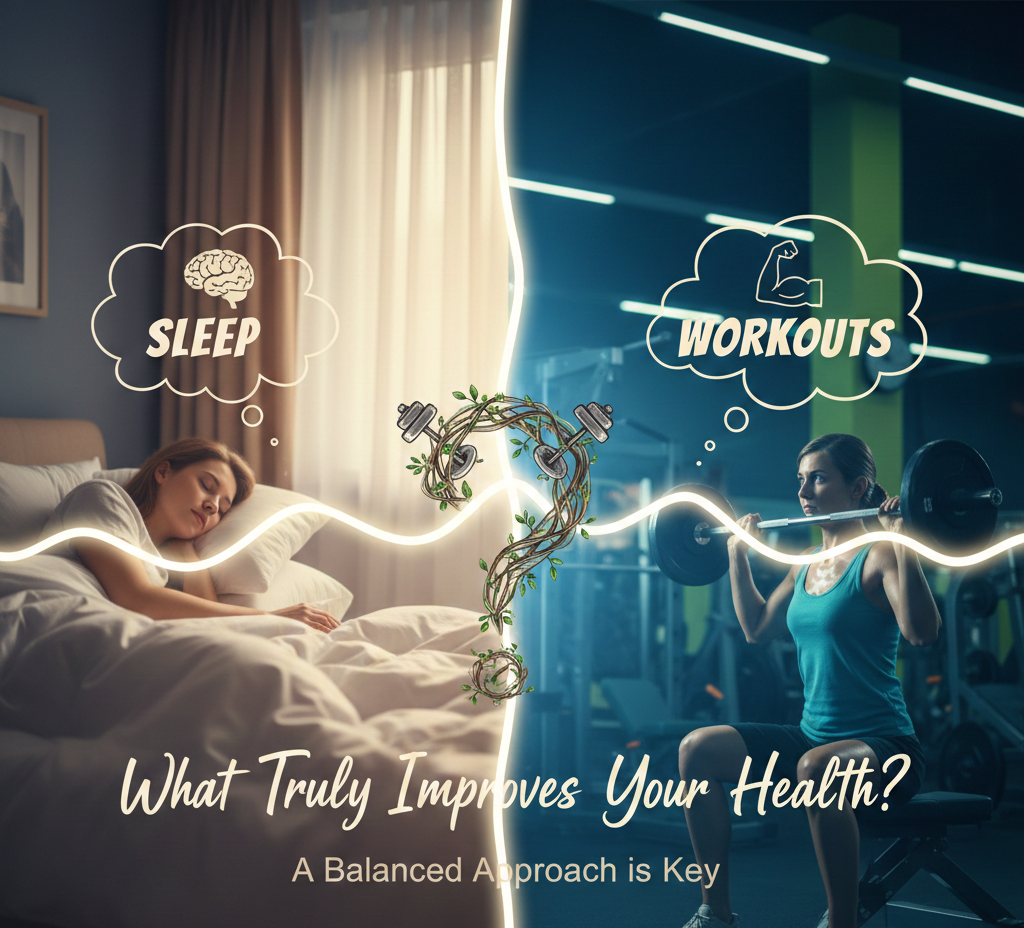
When it comes to improving health, two habits dominate every conversation: sleep and exercise. We are constantly told to move more, hit the gym, stay active—and at the same time, to sleep earlier, sleep deeper, and sleep longer. But when life gets busy and something has to give, a big question arises:
Is sleep more important than workouts, or do workouts matter more than sleep?
The honest answer is not simple. Both sleep and exercise are foundational pillars of health, yet they affect the body in different—and deeply interconnected—ways. This article breaks down the science, myths, and realities behind sleep and workouts, helping you understand what truly improves your health, when one matters more than the other, and how to balance both for long-term wellbeing.
Understanding the Foundations of Health
Human health is built on a few core pillars:
- Nutrition
Sleep or Workouts: What Truly Improves Your Health?
- Physical activity
- Sleep
- Mental and emotional balance
Among these, sleep and exercise are often the most neglected, even though they strongly influence every other aspect of health. You can eat perfectly, take supplements, and follow trends—but without sleep and movement, the body cannot function optimally.
What Sleep Really Does for Your Body
Sleep is not passive rest. It is an active biological process during which the body repairs, resets, and restores itself.
1. Physical Repair and Recovery
During deep sleep:
- Muscles repair and rebuild
- Tissues regenerate
- Growth hormone is released
- Inflammation is reduced
This is why athletes and trainers emphasize sleep as much as training.
2. Brain Health and Cognitive Function
Sleep is essential for:
- Memory consolidation
- Learning and focus
- Emotional regulation
- Decision-making
Chronic sleep deprivation is linked to:
- Brain fog
- Poor concentration
- Anxiety and depression
- Increased risk of neurodegenerative diseases
3. Hormonal Balance
Sleep regulates key hormones:
- Cortisol (stress hormone)
- Insulin (blood sugar control)
- Leptin and ghrelin (hunger and satiety hormones)
Poor sleep disrupts these hormones, leading to weight gain, cravings, and metabolic issues—even if you exercise regularly.
4. Immune System Strength
While you sleep, your immune system:
- Produces protective cytokines
- Fights inflammation
- Strengthens defense against infections
Lack of sleep increases susceptibility to illness and slows recovery.
The Power of Workouts and Physical Activity
Exercise is one of the most powerful tools for preventing disease and improving quality of life.
1. Cardiovascular Health
Regular physical activity:
- Strengthens the heart
- Improves circulation
- Lowers blood pressure
- Reduces risk of heart disease and stroke
Even moderate movement like walking has significant benefits.
2. Muscle, Bone, and Joint Health
Exercise:
- Preserves muscle mass
- Strengthens bones
- Improves joint mobility
- Reduces risk of falls and injuries
Strength training is especially critical as we age.
3. Mental and Emotional Wellbeing
Workouts boost:
- Endorphins (feel-good hormones)
- Serotonin and dopamine
- Stress relief and mood stability
Exercise is proven to reduce symptoms of anxiety and depression.
4. Metabolism and Weight Control
Physical activity:
- Improves insulin sensitivity
- Supports fat loss
- Helps maintain healthy body composition
However, exercise alone cannot fully compensate for poor sleep.
Sleep vs Workouts: The Real Comparison
Instead of choosing one over the other, it’s important to understand how they differ and interact.
Sleep Supports Exercise
- Muscles grow during sleep, not during workouts
- Recovery happens during rest
- Lack of sleep reduces strength, endurance, and coordination
Training hard without sleep increases injury risk.
Exercise Supports Sleep
- Physical activity improves sleep quality
- Reduces stress and anxiety
- Helps regulate circadian rhythm
However, overtraining can worsen sleep.
What Happens When You Exercise but Don’t Sleep Enough?
Many people try to “out-train” poor sleep. This strategy often backfires.
Effects include:
- Slower muscle recovery
- Increased cortisol levels
- Reduced fat loss
- Higher injury risk
- Mood swings and burnout
Research shows that sleep deprivation reduces athletic performance even in highly trained individuals.
What Happens When You Sleep Well but Don’t Exercise?
Adequate sleep without movement still leaves gaps in health.
Possible consequences:
- Muscle loss
- Poor cardiovascular health
- Reduced mobility
- Higher long-term disease risk
Sleep alone cannot maintain strength, endurance, or metabolic flexibility.
Which Is More Important for Weight Loss?
This is where the debate becomes intense.
Sleep’s Role in Weight Management
Poor sleep:
- Increases hunger hormones
- Reduces willpower
- Promotes fat storage
- Disrupts insulin sensitivity
Many people struggle to lose weight because they are sleep-deprived, not because they aren’t exercising enough.
Exercise’s Role in Weight Management
Exercise:
- Burns calories
- Preserves muscle
- Improves metabolism
But studies consistently show that sleep is a stronger predictor of weight gain than exercise alone.
The Verdict for Weight Loss
If forced to choose:
Sleep is more important than workouts for sustainable weight control.
However, the best results come from adequate sleep combined with regular movement.
Mental Health: Sleep vs Exercise
Both are powerful mental health tools—but they work differently.
Sleep and Mental Health
Sleep deprivation increases:
- Anxiety
- Depression
- Irritability
- Emotional instability
Without sleep, the brain struggles to regulate emotions.
Exercise and Mental Health
Exercise:
- Reduces stress hormones
- Boosts mood
- Improves self-confidence
But without sleep, these benefits are reduced.
For Mental Health, Which Comes First?
If someone is severely sleep-deprived, sleep should be prioritized first. Exercise can then enhance mental health once rest is restored.
Longevity and Disease Prevention
Both sleep and exercise play major roles in long-term health.
Poor Sleep Is Linked To:
- Heart disease
- Diabetes
- Obesity
- Dementia
- Weakened immunity
Lack of Exercise Is Linked To:
- Heart disease
- Muscle loss
- Osteoporosis
- Poor mobility
- Shortened lifespan
The longest-living populations prioritize both movement and rest.
Age, Lifestyle, and Individual Needs
For Busy Professionals
- Sleep deprivation increases burnout
- Short workouts are effective only when sleep is adequate
For Older Adults
- Sleep supports brain and bone health
- Strength training prevents frailty
For Athletes
- Sleep is performance-enhancing
- Overtraining without rest reduces gains
The Myth of “I’ll Sleep When I’m Done”
Modern culture glorifies:
- Hustle
- Late nights
- Early mornings
But chronic sleep loss silently damages health, productivity, and lifespan.
True productivity comes from rested focus, not exhaustion.
How Much Sleep and Exercise Do You Actually Need?
Recommended Sleep
- Adults: 7–9 hours per night
- Consistent schedule matters more than perfection
Recommended Exercise
- 150 minutes of moderate activity per week
- Strength training 2–3 times weekly
- Daily movement, not perfection
The Ideal Balance: Not Sleep or Workouts, But Both
Instead of asking which is more important, ask:
- Am I sleeping enough to recover?
- Am I moving enough to stay strong?
- Am I listening to my body?
On days when sleep is poor:
- Reduce workout intensity
- Focus on walking or mobility
On days with good sleep:
- Train harder and progress
Final Verdict: What Truly Improves Your Health?
If forced to choose in extreme situations:
- Sleep is the foundation
- Exercise builds on that foundation
Without sleep:
- Exercise effectiveness drops
- Hormones suffer
- Health declines
Without exercise:
- Strength and longevity decline
Sleep keeps you alive. Exercise helps you thrive.
The healthiest people don’t choose between the two—they respect both.
Final Thoughts
Sleep and workouts are not rivals. They are partners.
Sleep restores your body.
Exercise strengthens it.
Together, they create resilience, energy, mental clarity, and long-term health.
If you want better health, don’t ask for sleep or workouts—ask how to do both better.
Sleep vs Workouts – Health Impact Comparison Chart
| Aspect | Sleep | Workouts (Exercise) |
| Primary Role | Body & brain recovery | Strength, stamina & fitness |
| Effect on Brain | Improves memory, focus, mood | Reduces stress, boosts mood |
| Hormone Balance | Regulates cortisol, insulin, hunger hormones | Supports hormone sensitivity |
| Weight Management | Prevents cravings & fat storage | Burns calories & preserves muscle |
| Muscle Health | Muscle repair & growth happens | Muscles are trained & stressed |
| Energy Levels | Restores daily energy | Builds long-term endurance |
| Immune System | Strengthens immunity | Improves immune response |
| Heart Health | Supports blood pressure control | Strengthens heart & circulation |
| Mental Health | Prevents anxiety & depression | Reduces stress & boosts confidence |
| Risk if Ignored | Hormonal imbalance, burnout | Weak muscles, poor mobility |
| Can It Replace the Other? | ❌ No | ❌ No |
| Best Result | ✔ When combined with exercise | ✔ When combined with good sleep |

1 comment
[…] refuses to budge. Frustrating, isn’t it? You may feel like you’re doing everything right, but weight loss is far more complex than just diet and […]